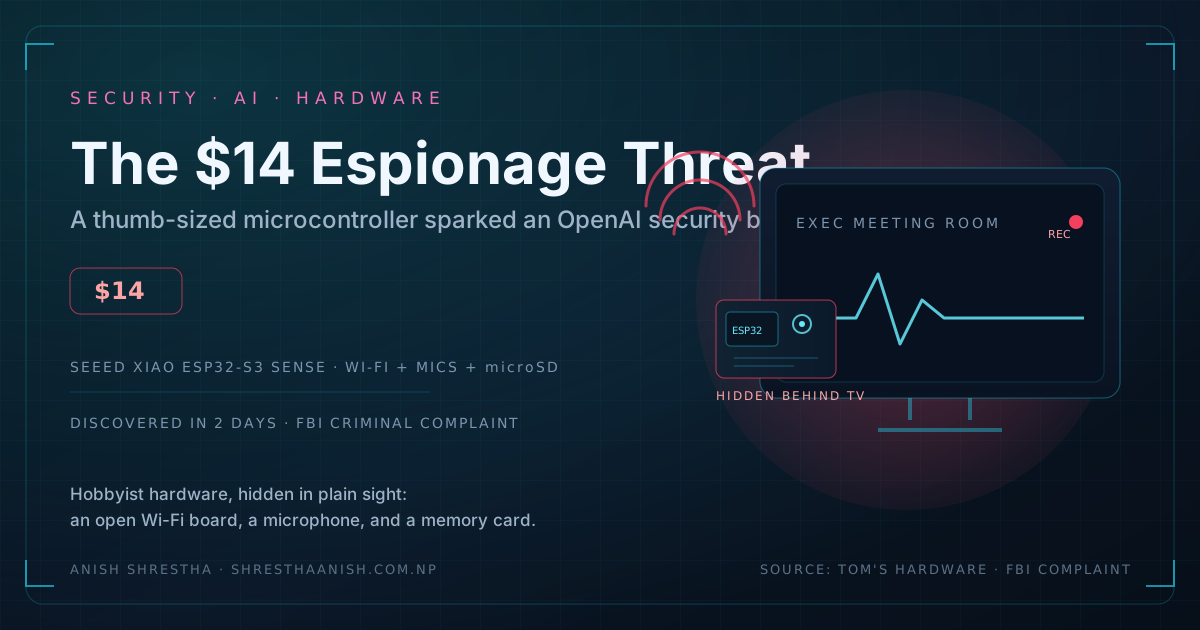
The $14 Espionage Threat: How a Cheap Microcontroller Sparked an OpenAI Security Breach
A 35-year-old software engineer was arrested for planting a $14 microcontroller listening device inside an OpenAI executive meeting room.
An Unexpected Attack Vector
When you picture high-stakes corporate espionage in the artificial intelligence sector, you probably imagine sophisticated cyberattacks, state-sponsored hacking groups, or complex supply chain compromises.
What you usually do not picture is $14 worth of off-the-shelf hobbyist hardware taped behind an executive television and hidden with toilet paper.
As reported by Tom's Hardware, 35-year-old OpenAI software engineer Abdulrahman Alfozan, a Saudi Arabian national, was recently arrested by federal authorities. The Department of Justice alleges that Alfozan installed a covert recording device inside an executive conference room at OpenAI's offices to eavesdrop on sensitive discussions regarding the company's superintelligence research.
The Hardware: A $14 Hobbyist Board
The hardware used in the attempt was surprisingly modest. According to the FBI criminal complaint, the listening device was a Seeed Studio XIAO ESP32-S3 Sense, a thumb-sized development board that retails for around $14 online. Despite its low price tag, the board packs significant features:
- An ESP32-S3 microcontroller with Wi-Fi and Bluetooth LE connectivity
- A built-in digital microphone
- A microSD card slot for local storage
- A detachable camera sensor module
How the Security Breach Unraveled
The device was attached to the back of a television set inside an executive meeting room around late September and covered with toilet paper to blend into the surroundings. It was discovered by security personnel just two days later. The investigation unraveled quickly due to basic operational security failures and digital breadcrumbs left behind:
- Internal Tools: Investigators found that Alfozan had used internal company tools to map out leadership schedules, executive calendars, and meeting room locations.
- Chatbot Audit Logs: In an ironic twist for an AI company employee, Alfozan reportedly used a chatbot account associated with his spouse to research how to execute the plot, including queries on how to continuous-record audio, customize Wi-Fi connectivity, and encrypt the SD card.
- Hardware Signatures: Prompts submitted to the chatbot even referenced the exact custom header configurations and the unique MAC address of the specific ESP32-S3 board found taped to the TV.
- Physical Inspection: Security footage captured Alfozan checking the back of the television after installation. When OpenAI security inspected his unattended bag, they found a second, matching ESP32 recording setup alongside his personal identification.
The Broader Physical Security Impact
Federal authorities, including the FBI, are investigating whether Alfozan acted as a lone actor, was working on behalf of a rival corporate entity, or was operating under the direction of a foreign state actor.
For years, major AI labs like OpenAI and Anthropic have warned about online distillation attacks and digital model theft. However, this incident marks one of the first high-profile physical espionage arrests inside the physical headquarters of a major American AI developer.
As artificial intelligence systems become vital national and economic infrastructure, physical security is coming under the same scrutiny as software security. High-tech AI models can be compromised not just through digital vulnerabilities, but by basic $14 microcontrollers hidden in plain sight.