The Day the Bots Went Quiet: How Drone Strikes Plunged Russian Big Tech into Chaos
Ukrainian long-range drones struck Yandex's data centres in Sasovo, Kaluga and Vladimir — and automated traffic from Russia's largest tech network collapsed to 0.4% of its normal volume.
If the web feels quieter, you are not imagining it
In a dramatic shift in how modern wars are fought, Ukrainian long-range drones targeted the heart of Russia's digital infrastructure — and the ripple effects were felt globally almost immediately.
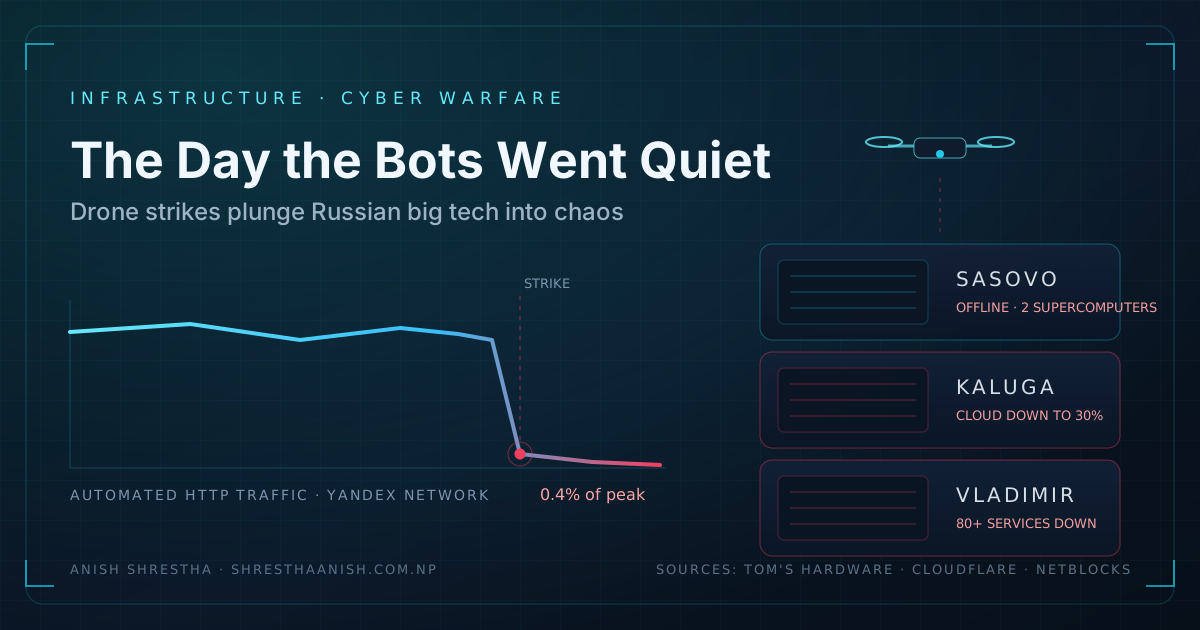
Following strikes on major data centres belonging to Yandex, often called Russia's Google, automated bot traffic originating from their network dropped off a cliff. Network monitoring firm Cloudflare logged a massive drop, showing automated HTTP request traffic from Yandex plummeting to a mere 0.4% of its typical two-week high. To put that into perspective: an entire nation's digital automated footprint practically disappeared overnight.
How the escalation unfolded
According to coverage from Tom's Hardware, this digital blackout was the result of a rapid back-and-forth escalation in the ongoing conflict.
First, Moscow executed strikes against Ukrainian digital infrastructure in Kyiv, aiming to sever communications and military intelligence capabilities. Kyiv then retaliated by launching long-range drone strikes on Yandex's high-tech facility in Sasovo, roughly 195 miles southeast of the Kremlin. That centre housed two of Russia's top supercomputers, and network metrics showed an immediate drop in Yandex automated traffic to around 57%.
Over the next few days, additional Ukrainian drone strikes hit Yandex's massive data centre complex in Kaluga, as well as a third facility in Vladimir. By the time the smoke cleared, over 80 critical cloud and consumer services were completely offline.
- Sasovo — two top supercomputers housed; automated traffic fell to ~57%
- Kaluga — Yandex's massive data centre complex hit
- Vladimir — third facility struck
- Result: 80+ critical cloud and consumer services offline
What knocking out Yandex actually means
Yandex is far more than a search engine. It is the digital backbone of the Russian economy, handling everything from taxi hailing and food delivery to online banking backends, cloud databases and AI platforms.
NetBlocks reported that Yandex Cloud traffic plunged to 30%, while main Yandex LLC traffic fell to roughly 63%. Average citizens suddenly found themselves unable to access everyday mobile apps, order rides or process online payments. To make matters worse for local users, alternative fallbacks are not readily available because Starlink does not operate in Russia and domestic satellite programmes have suffered major launch setbacks.
The impact also extends directly to web automation. While cybersecurity researchers debate how much of this missing traffic was state-sponsored propaganda bots versus everyday commercial scrapers and automated cloud tasks, the outcome is the same: the physical infrastructure hosting those automated routines was destroyed.
A new era of physical and cyber warfare
For years, people thought cyberwarfare just meant hackers in dark rooms trading lines of malicious code. Today, the battlefield looks completely different.
Military targets are no longer limited to fuel depots, airfields or supply trucks. Data centres powering the cloud have become high-priority objectives. Ukraine's use of custom long-range kamikaze drones capable of flying over 1,500 miles has proven that high-value digital assets deep behind the front lines are vulnerable.
This trend is not isolated to Eastern Europe. As Tom's Hardware highlighted, the line between civilian tech infrastructure and military targets is blurring fast around the world, as seen recently in the Middle East where AWS data centres in Bahrain and the UAE faced drone strikes during regional flare-ups.
The lesson here is simple. The cloud does not live in the sky; it lives in concrete warehouses full of servers. When those warehouses get hit, the entire world notices the silence.
Background & context (via Tom's Hardware)
The targets: over the course of four days, Ukrainian long-range strike drones targeted Yandex's primary data centre facilities in Sasovo, Kaluga and Vladimir. These facilities housed the company's core server infrastructure and all three of its supercomputers, which power Yandex's consumer ecosystem, cloud platform and artificial intelligence models.
The "bot" clarification: Cloudflare's report that bot traffic from Yandex fell to 0.4% refers strictly to automated HTTP web traffic. In cybersecurity terms this includes non-malicious background tasks such as search engine crawlers, cloud server API calls, automated data scrapers and app backend scripts. While some political propaganda bots may have used these cloud servers, the steep decline primarily reflects the physical shutdown of Yandex's automated web processing scripts.
Why data centres matter: data centres have transitioned from soft infrastructure into high-value military objectives. Both belligerents rely on commercial cloud networks for battlefield logistics, drone telemetry analysis, satellite imagery distribution and civil-military coordination. Physical strikes on these facilities represent an unprecedented convergence of kinetic drone strikes and digital infrastructure warfare.